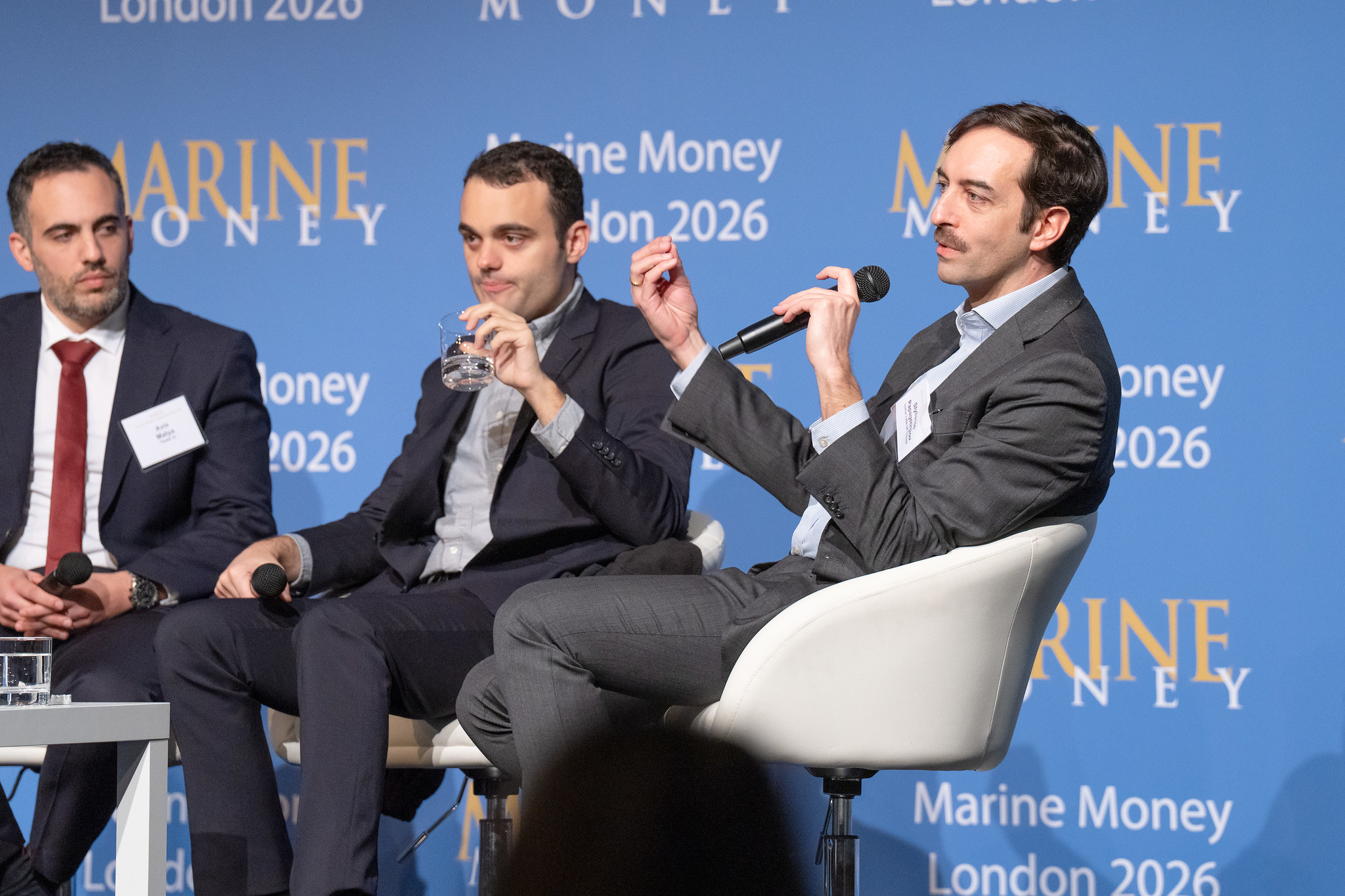
At the Marine Money London Ship Finance Forum 2026, a panel titled “Technology and AI: A Driver to Move Shipping Forward” brought together shipowners, operators, and technology providers to examine how artificial intelligence is beginning to reshape shipping in practical terms.
Moderated by Rogerio Alves of the London Maritime Academy and hosted at JW Marriott Grosvenor House, Park Lane the discussion featured perspectives from Lise Duetoft of Hoegh Autoliners, Konstantinos Kyriakopoulos of DeepSea Technologies, Aviv Matya of Thetis AI, and Stylianos Papageorgiou, Managing Director of lomarlabs. Rather than cataloguing tools or forecasting distant futures, the conversation focused on what AI already enables—and what it will quietly change next.
Stylianos’ contribution centred on three ideas that frame AI’s real significance for shipping.
1. AI enables the transfer of hard-earned skills
One of the most immediate impacts of AI in shipping is its ability to transfer time-earned skills from highly experienced professionals to a wider workforce.
Shipping depends on judgement built over decades—often tacit, contextual, and difficult to scale. AI changes that dynamic by capturing patterns and signals from experienced practitioners and making that expertise usable by others who have not had the same time to accumulate it.
Stylianos illustrated this through lomarlabs’ collaboration with Signal Fusion, which uses AI-powered, short voice check-ins with seafarers to detect subtle behavioural cues—such as fatigue, communication breakdowns, or friction—that can signal operational risk. Voice offers a simple, non-invasive way to capture objective indicators of cognitive and emotional state, helping teams spot early warning signs, support more ships without adding headcount, and enable more human, empathetic follow-ups across the fleet.
2. Every solution creates a transition challenge
Like every major technological shift, AI solves old problems while creating new ones. In shipping, that tension is already visible.
Roles will change. Some will disappear. New ones—many not yet clearly defined—will emerge. The central challenge is not whether this transition will happen, but how organisations support people through it.
Stylianos framed upskilling and knowledge retention as essential conditions for adoption. Here, AI plays a paradoxical role: by embedding knowledge into tools, it can help ease the very transition it accelerates—supporting decision-making rather than replacing it.
3. The deepest impact of AI will be indirect
While much attention is focused on operational use cases—routing, efficiency, automation—Stylianos argued that AI’s most profound impact on shipping will be indirect.
AI is reshaping the wider world in which shipping operates: energy production, energy transportation, industrial manufacturing, and global trade patterns. Those shifts will influence what goods are produced, where they are made, and how they are moved. In that sense, AI is not only an operational consideration for shipping, but a strategic one—shaping demand, routes, and cargo flows over time.
A grounded way forward
What emerged was a grounded view of where AI is heading in shipping. Not as an overnight disruption, but as a structural shift that will unfold over time. Progress will favour organisations that focus on execution, invest in people, and treat AI as part of a wider system rather than a standalone solution. The task ahead is not to adopt AI for its own sake, but to make it useful, responsible, and operationally relevant.